Is Lord Voldemort's grave in Edinburgh? The Truth About Thomas Riddell's Tomb in Greyfriars Kirkyard
Edinburgh Council once had to say, in public, that the ground around one particular gravestone in Greyfriars Kirkyard was eroding more than it should due to the weight of visitors.
The tomb wasn't the one of a king, or a poet, nor even a famous dog. Two captains named Thomas Riddell, a father and a son. You know why. Tom Riddle was the orphan boy who became the Dark Lord in the Harry Potter books, and a grave with almost the same name sits a few minutes' walk from some of the coffee shops where J.K. Rowling wrote. It has everything a good myth needs: a graveyard, a villain, and a surname that is one letter away from the real thing.
What the stone actually says
I took the photo myself, so this is word for word, including the spelling of the 1800s stonemason:
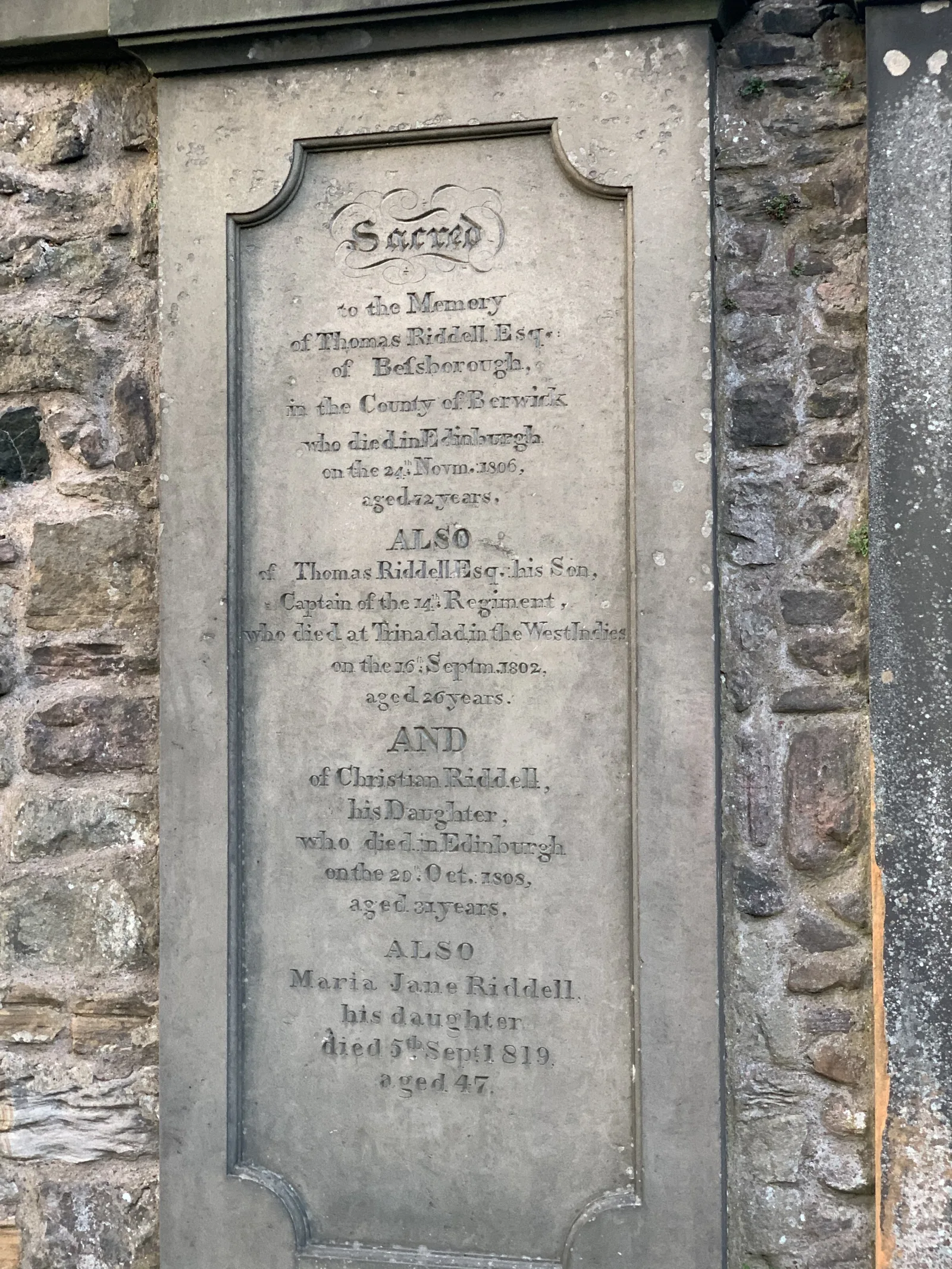
This isn't one grave for one man. It's a family memorial: a father, a son, and two daughters, with the name of the last daughter added years later. There are two Thomas Riddells on it, the father and the son.
The "star of the show" would be Thomas Riddell junior, who was a captain in the 14th Regiment. He died in Trinidad, aged 26, thousands of miles from home. According to the regiment's own published history, the 14th Foot was garrisoning Trinidad from the end of 1800 until 1803, so the Peace of Amiens was already signed when he died. Nothing on the registers says how. A young captain, far from home. That's the real story, and honestly it's better than the myth.
And his father? Thomas Riddell senior was a sea captain with the East India Company. His father was Sir Walter Riddell, 5th Baronet. Thomas Riddell Sr. was captain of the Admiral Pocock ship on trading voyages to Bombay, Manila and China. In March 1771, at the Cape of Good Hope, Captain James Cook handed him letters for the Admiralty and the Royal Society. Later in his life, he commanded the Bessborough. In 1775 he bought Lord Kames's old estate in Berwickshire and named the house after that ship. That is why the stone says "of Besborough".
The Tom and Tom coincidence
Here's the part the tour guides get excited about, and fairly so. In the books, Voldemort is born Tom Marvolo Riddle, the son, named after his Muggle father, Tom Riddle Sr. A son sharing his father's first name and surname. The stone in Greyfriars carries a son sharing his father's first name and surname, and he is the one the guides point at.
I'll leave that there and let you draw your own conclusions. Just notice one detail before you do: it's Riddell on the stone, Riddle in the books. Similar, not identical.
Right, so what has J.K. Rowling actually said?
This is where we bring out the magnifying glass, and for once the author gave us a straight answer.
In July 2022, she wrote on Twitter about the kirkyard, replying a fan:
"I know the graveyard you're talking about because unbeknownst to me, one of my children was at a loose end one afternoon and went on one of those Potter walking tours with their best mate for a laugh. They came home with a ton of information that was news to me."
In September 2024, Rowling wrote on Twitter, nowadays X:
"Today I heard a tale of the guff claimed as fact on a 'Potter tour' of Edinburgh, and now I'm considering hiring a bus and auctioning places on it for charity and spending an afternoon debunking the nonsense and pointing out bits no-one knows and then we could all go to the pub."
Replying to a fan on the same thread, Rowling stated:
"It's 'Thomas Riddell' and I've still never seen the grave and the anagram wouldn't work (because 'Tom Marvelo Riddle' came after I'd invented Lord Voldemort. But I've never pointed out the church plaque I genuinely got the name Lockhart from."
Our verdict: myth
What is verified: the stone is real, there were two men called Thomas Riddell, and Rowling spent years writing within a short walk of the kirkyard.
What is not: any link between that particular grave and Voldemort. The author says she has never seen it, and that "Tom Marvolo Riddle" only came after she had invented Lord Voldemort. Verdict, then: a wonderful coincidence, and a myth as an origin story.
So if a guide tells you it's confirmed that this is where Voldemort's name came from, you now know better. Coincidences are allowed to be wonderful without that meaning they are proof!
When you visit, spare a thought for the 26-year-old captain who never made it home, and for the sea captain named beside him. They are the real people on that stone. And please keep to the path: that erosion was not a figure of speech. It is getting pretty bad.
Sources
- J.K. Rowling on X, September 2024 (the "Potter tour" thread).
- Newsweek, "JK Rowling Hits Out at Edinburgh 'Harry Potter' Tour—'Nonsense'" (19 September 2024):
- Edinburgh Evening News, "J.K. Rowling denies Edinburgh locations like Victoria Street and Greyfriars Kirkyard inspired Harry Potter books" (11 July 2022):
- James Brown, The Epitaphs and Monumental Inscriptions in Greyfriars Churchyard (1867), page 170.
- Richard Cannon, Historical Record of the Fourteenth or the Buckinghamshire Regiment of Foot.
- Three Decks, East Indiaman Admiral Pocock (voyages under Capt Thomas Riddell, India Office records).
- Captain Cook Society, Cook's journal January to March 1771 (Cape of Good Hope).
- The Berwickshire Place-Name Resource, Kames (sale of the estate to Thomas Riddell in 1775).
- Photograph of the stone: author's own.